
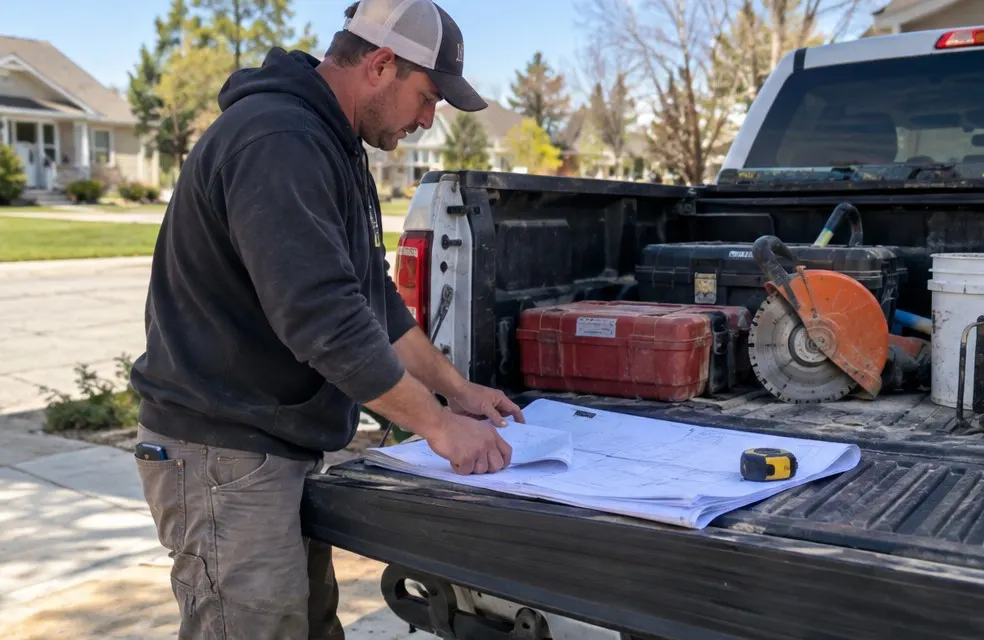
Most people who start a concrete business already know how to pour. They worked on someone else's crew for a few years, they can set forms and run a bull float, and they are tired of making the owner rich. The concrete part is the easy part. The business part is what sinks new contractors. Here is how to start in the right order.
1. Pick the work you will do first
Start with residential flatwork: driveways, patios, sidewalks and small slabs for sheds and hot tubs. It is the work with the most demand, the simplest engineering and the easiest pricing, because it all comes down to square feet. A small crew of two or three can do one or two of these a week from day one.
Leave foundations, structural walls, commercial slabs and anything that needs a stamped engineering plan for later. They need bonding, bigger crews and cash to float materials for 30 to 60 days while a general contractor pays you.
2. Handle the paperwork
- Register the business with your state. An LLC is common and costs $50 to $500 depending on the state
- Get an EIN from the IRS. It is free and takes ten minutes online
- Check contractor licensing. Many states require a contractor license for jobs above a dollar amount, and some cities want their own license or registration. Your state's contractor licensing board has the rules
- Learn the permit rules. Many cities want a permit for a new driveway approach or anything touching the city sidewalk. Know it before you quote
- Get general liability insurance. Expect $1,500 to $4,000 a year for a $1 million policy as a new concrete contractor. Homeowners and property managers will ask for the certificate
- Workers' comp as soon as you hire, usually required by law
- Open a business bank account so every dollar is tracked from day one
3. Equipment: buy some, rent the rest
You do not need a mixer truck. Ready-mix plants deliver. A realistic starter list:
- A truck and a dump trailer, for forms, base and hauling old concrete. A used dump trailer runs $5,000 to $10,000
- Forms and stakes: 2x4 and 2x6 lumber, steel stakes, a few flexible forms for curves, $500 to $1,000
- Finishing tools: screeds, a bull float, a darby, hand floats, edgers, groovers, brooms, knee boards, $800 to $1,500
- Wheelbarrows, rakes, shovels and a concrete rake (come-along), $400
- A plate compactor, $800 to $1,500 new, or rent it
- Rebar cutter and bender, mesh, chairs and tie wire, bought per job
- Rent per job: walk-behind concrete saw for control joints, power trowel, skid steer, jackhammer or breaker for tear-outs
Most owners who already have a truck start for $10,000 to $25,000. Rent the expensive machines until you use them every week.
4. Understand your material costs
Ready-mix runs roughly $150 to $200 a cubic yard in most US markets, more in big metros, and small loads often carry a short-load fee. At 4 inches thick, one cubic yard covers about 81 square feet, so concrete alone costs about $2 to $2.50 a square foot. Add the gravel base, mesh or rebar, forms, sealer and saw blades, and materials land around $3 to $4 a square foot before labor.
5. Set your prices before your first call
Price by the square foot with a starting price that covers the smallest job you will take. A common setup for a plain 4-inch driveway is $2,400 for the first 200 square feet and $9 a foot after that, which makes a 600 square foot driveway about $6,000. Our guide on how much to charge for concrete per square foot walks through the full method.
6. Book your first jobs
- Pour for friends and family at a fair price and take sharp photos of each finished job, from the street and up close
- A Google Business Profile with your photos, service area and phone
- Yard signs on every job for a week after the pour, with permission
- Builders, landscapers and pool companies who need a concrete sub they can trust
- A website with prices, so people who see your sign can look you up at night. A concrete contractor website that shows a price range gets more calls than one that says "call for a free estimate"
Read how to get concrete customers for the full playbook.
7. Set up simple systems now
Take a deposit when the job is booked, enough to cover the concrete, and collect the balance when the work is done. Write down every job: address, square feet, price, deposit, pour date. Text a review request the week after. It is far easier to start with a system than to fix the mess after 50 jobs.
How fast it grows
Many owners start with two people and a trailer and add a second crew in year two or three. In the South the work runs most of the year; up north the season is April to November and the winter goes to bids, equipment repair and planning. Read concrete weather and season planning before you plan your first year.
Frequently asked questions
How much does it cost to start a concrete business?
Owners who already have a truck usually start for $10,000 to $25,000: a dump trailer, forms, finishing tools, a compactor, insurance and registration. Saws, power trowels and skid steers are rented per job at first.
Do I need a license to start a concrete business?
Often, yes. Many states require a contractor license above a job value, and cities may need their own registration and permits for driveway approaches. Check your state licensing board and your city.
Is a concrete business profitable?
It can be. Residential flatwork often carries a 25 to 40 percent gross margin when it is priced by the square foot with a real minimum, and deposits keep cash flow healthy.